
Quick Summary
Addressing hardwood floor water damage repair in Elmhurst requires swift action to extract trapped subfloor moisture before permanent cupping, buckling, or mold growth forces complete floor replacement. Wade's Restoration prioritizes material preservation over unnecessary demolition by deploying specialized vacuum drying panels and commercial dehumidifiers to salvage original hardwood planks within the critical mitigation window. Readers will learn how in-place structural drying prevents permanent crowning and can call 24/7 for immediate dispatch, a free visual inspection, and a specialized hardwood floor drying evaluation.
Hardwood Floor Water Damage Repair in Elmhurst: Assessment and Restoration Options
When dealing with water-damaged hardwood floors in Elmhurst, acting promptly is essential. Water from a burst radiator line, plumbing leak, or heavy rainstorm quickly penetrates into tongue-and-groove planks and the subfloor beneath. Prompt moisture removal is important, and the first 24 to 48 hours are critical for reducing mold risk, though this does not guarantee preservation or mold prevention. Some floors may recover, while buckling, separated boards, contaminated water, or subfloor damage may require partial or full replacement.[2]
Professional restoration, such as that provided by Wade’s Restoration – East New York, focuses on evaluating whether drying and restoring original hardwood is viable. Depending on the situation, possible professional techniques include the use of moisture meters, specialized vacuum extraction mats, and commercial dehumidification systems to remove trapped moisture. Property owners should review their insurance policy and consult their insurer and qualified professionals regarding documentation and coverage requirements.[4]
Consult a qualified restoration professional for an on-site evaluation of water-damaged hardwood floors.
Can water-damaged hardwood floors be saved?
Quick answer: Some water-damaged hardwood floors may recover if prompt moisture removal begins quickly, the water is uncontaminated, and the planks have not sustained severe structural damage. However, buckling, separated boards, contaminated water, or subfloor damage may require partial or full replacement. Possible professional techniques, such as specialized vacuum mat systems, may help extract moisture from wood and subfloor layers depending on the assessment.[3]
Rushing to sand wet, cupped floorboards or applying direct high heat can cause further damage. Sanding swollen wood removes material that planks need to return to their shape once dry, which can lead to crowning. Controlled drying helps stabilize moisture levels, though outcomes depend on the extent of the damage.
The urgent mitigation window
Prompt moisture removal is important, and the first 24 to 48 hours are critical for reducing mold risk, according to the Environmental Protection Agency (EPA), which notes that mold can begin growing on damp organic materials within 24 to 48 hours. Regional data shows that New York City identifies flood-priority areas, including locations in Southeast Queens, and Queens has documented flood exposure, but no verified Elmhurst-specific hardwood-floor repair statistics are available. Quick mitigation helps contain moisture spread and protect indoor air quality.[1]
Assessing floors before demolition
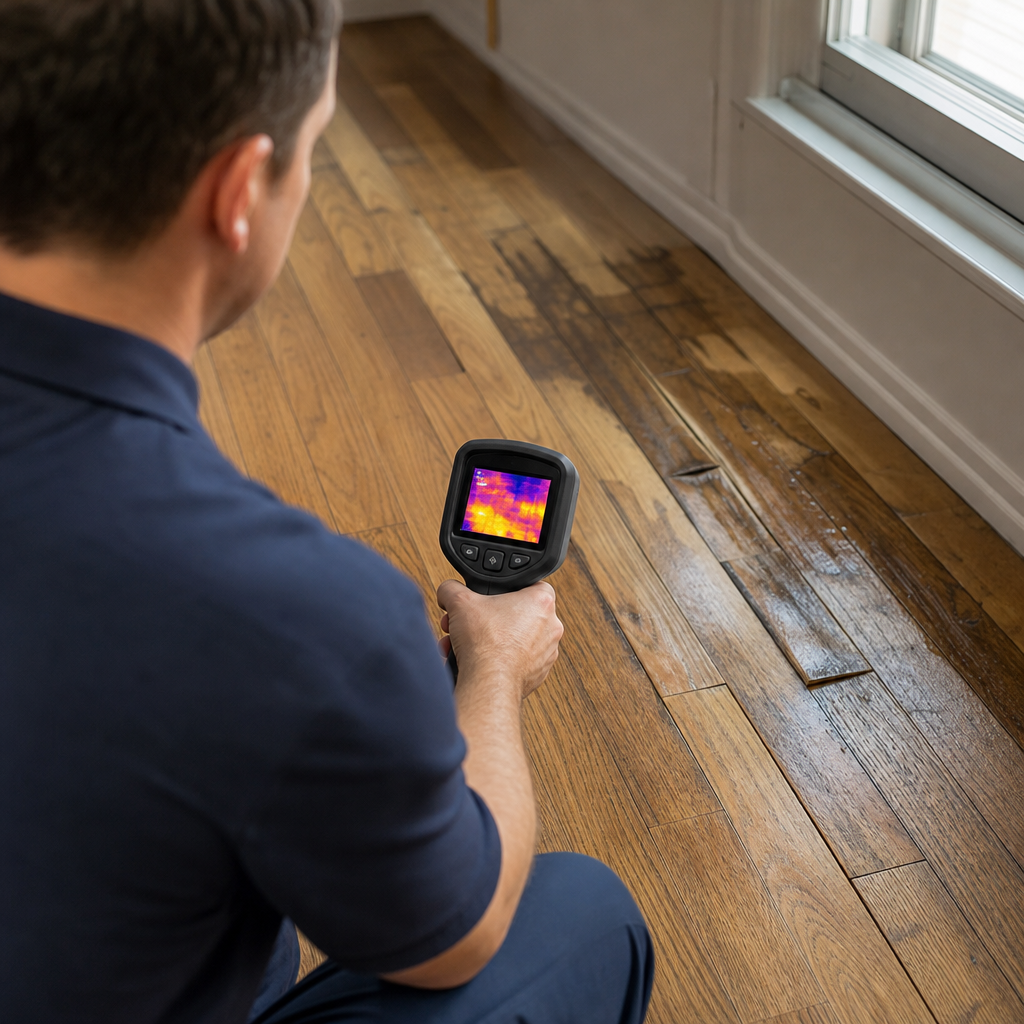
Restoration technicians may assess affected areas using tools such as moisture meters or thermal imaging cameras as possible evaluation methods to determine how far moisture has traveled through the surface planks and underlying subfloor. If the fasteners hold and the wood remains structurally sound, in-place structural drying may be considered when the floor, subfloor, and water conditions make restoration appropriate.
How do specialists dry hardwood floors and subfloors without tear-out?
Extracting water trapped between hardwood planks and the subfloor may involve specialized professional drying equipment rather than basic household fans or dehumidifiers.
Moisture extraction and drying cautions
When wood absorbs water, the bottom of the plank often expands faster than the finished top surface, causing the edges to curl upward (cupping). Sanding raised edges while the floor is wet can cause permanent crowning once the subfloor dries. Examples of possible professional techniques used during structural drying include:
- Placing sealed vacuum drying panels over affected hardwood boards.
- Applying negative-pressure airflow through joints to help draw trapped moisture from the subfloor.
- Using commercial low-grain refrigerant (LGR) dehumidifiers to extract evaporated moisture from the air.
- Positioning directed air movers across the surface to promote evaporation without overheating the wood.
Restoring wood equilibrium moisture content (EMC)
Hardwood floors in the New York area naturally rest at an equilibrium moisture content between 6% and 10%, depending on the season. Significant water exposure can raise moisture levels considerably. Restoration technicians, such as the specialists at Wade’s Restoration – East New York, typically monitor moisture readings in both surface boards and the subfloor until readings approach unaffected baseline levels.
Managing subfloors and structural joists underneath
Drying only the surface of the floor may leave underlying subflooring and support joists damp. Trapped moisture can contribute to deterioration, fastener failure, or microbial growth. When lower-level access is available, technicians may direct airflow toward the subfloor structure to assist the drying process.
What does hardwood floor water damage repair cost in Elmhurst?
Need hardwood floor water damage repair in Elmhurst?
We’re available now - call for a fast, free estimate.
An unverified commercial estimate places costs in East Elmhurst between $250 and $4,500, but authoritative neutral sources do not establish a local average cost for Elmhurst. Actual costs depend on site conditions, the extent of damage, square footage, and subfloor stability, and an on-site inspection is required to determine pricing.[5]
Typical local restoration approaches
| Restoration Method | In-Place Specialized Drying | Early Surface Sanding | Full Floor Tear-Out |
|---|---|---|---|
| Preserves Original Hardwood | Possible (depends on floor condition) | No (can cause crowning) | No |
| Dries Subfloor Assembly | Possible (technique dependent) | No | Yes |
| Restoration Cost | Varies by site conditions | May lead to replacement costs | Higher replacement cost |
Key cost drivers: water category, floor area, and subfloor damage
Clean water leaks from supply pipes may permit in-place drying if addressed quickly. In contrast, contaminated water, such as floodwater or sewage backups (Category 3 water), may require removal and replacement of affected materials, depending on the contamination and professional assessment. Total affected area and the type of subfloor also influence necessary labor and equipment.
Navigating insurance claims and moisture logs
Property owners should review their insurance policy terms and consult their insurance representative and qualified restoration professionals to understand claim requirements, documentation standards, and coverage limits for water damage.
How do you know if mold or subfloor rot is spreading under wood floors?
Trapped moisture beneath wood flooring may not be immediately obvious. Watch for these potential signs following a water intrusion:
Visible cupping, dark staining, and spongy floorboards
If plank edges remain cupped long after surface water has been removed, moisture may remain in the subfloor. Dark staining, persistent moisture, or musty odors warrant professional evaluation rather than assuming they will resolve on their own. If boards feel soft or spongy underfoot, subfloor materials may have sustained structural damage.
Musty odors and hidden microbial growth under baseboards
Persistent musty odors near baseboards or perimeter walls suggest trapped dampness that warrants professional evaluation. Restoration contractors may use containment measures, HEPA filtration, or antimicrobial treatments as appropriate based on on-site findings.
When to repair vs when to replace structural components
Decisions regarding repair or replacement depend on safety, contamination levels, and material condition:
- Drying and Restoration: May be considered when water is clean, boards remain securely attached, and prompt mitigation begins before significant deterioration occurs.
- Partial or Full Replacement: May be required when planks have severely buckled, wood has split or delaminated, subflooring has lost structural integrity, or materials have been exposed to contaminated water.
Frequently asked questions about hardwood floor restoration in Elmhurst
Here are answers to common questions property owners ask when dealing with wet wood floors.
How much does hardwood floor water damage repair cost?
An unverified commercial estimate for East Elmhurst suggests costs ranging from $250 to $4,500, but authoritative neutral sources do not establish a local average cost. Actual costs depend on site conditions, contamination level, and the scope of repairs, requiring an on-site inspection.
How fast should an emergency water mitigation team arrive?
Property owners should contact qualified emergency restoration services like Wade’s Restoration – East New York as soon as possible after discovering water damage to arrange an prompt assessment and begin moisture removal.
Can cupped hardwood floors flatten out on their own?
Minor moisture absorption may diminish as humidity normalizes, but significant cupping typically requires professional drying methods to address trapped subfloor moisture. Some floors may recover, while permanently distorted or buckled boards may require replacement.
Does homeowners insurance cover water-damaged wood floor repair?
Coverage depends entirely on individual policy terms, the cause of the loss, and exclusions. Property owners should review their policy carefully and consult their insurance company and qualified professionals regarding coverage and claim procedures.
Need hardwood floor water damage repair in Elmhurst?
We’re available now - call for a fast, free estimate.
Sources
- 1 – nyc.gov (2099)
- Billion-Dollar Weather and Climate Disasters | New York Summary – ncei.noaa.gov (2024)
- New York City Council Committee on Environmental Protection … – nyc.gov (2024)
- Ten Years After Sandy – Office of the New York City … – comptroller.nyc.gov
- Severe Weather Events and Resiliency in New York State – osc.ny.gov
Frequently Asked Questions
How long does in-place hardwood floor drying typically take?
Specialized in-place structural drying typically takes between 3 to 7 days depending on the water volume, subfloor saturation, and wood species. Wade's Restoration deploys negative-pressure vacuum mats and commercial dehumidifiers to safely draw out trapped moisture, continuously testing moisture levels until the wood reaches its standard equilibrium.
When is it safe to sand and refinish hardwood floors after water damage?
Hardwood floors should never be sanded while planks remain damp or cupped, as premature sanding permanently crowns the wood once the subfloor finishes drying. Refinishing must wait until moisture meters verify that both the surface planks and subflooring have returned to their normal baseline moisture content. Wade's Restoration provides specialized drying evaluations to ensure materials are fully stabilized before any cosmetic repairs begin.
What immediate steps help prevent floor buckling before restoration technicians arrive?
Stop the water source immediately, remove standing surface water with towels or mops, and avoid applying direct high heat that can warp wood fibers. Calling Wade's Restoration for 24/7 emergency dispatch ensures commercial extraction equipment arrives within the critical mitigation window to salvage original floorboards.
About the author
 |
Marcus Bradley Marcus Bradley is a certified water damage restoration technician with over a decade of experience handling residential and commercial property emergencies. He holds a degree in Construction Management from the New York Institute of Technology and specializes in rapid moisture mitigation and structural drying techniques. Marcus provides actionable advice to help property owners minimize loss and navigate the complexities of restoration and insurance claims. |
Water damage, flood, or mold emergency?
We’re available now - call for a fast, free estimate.
Call Now - Free Estimate