
Quick Summary
Water damage restoration in East New York requires rapid intervention to protect historic 1920s to 1940s brick row houses and plaster walls from rot and mold. Wade's Restoration provides an estimated 45-minute emergency response, utilizing non-invasive cavity drying and end-to-end insurance documentation to preserve architectural integrity while avoiding costly demolition. Readers will understand the local mitigation process and can contact Wade's Restoration 24/7 for immediate structural extraction and a free visual inspection with an itemized scope of work.
Water Damage Restoration in East New York – Fast 45-Min Target Response
When you need water damage restoration in East New York, Wade’s Restoration aims to arrive on-site within an estimated 45-minute response window under standard local conditions to extract standing water and start structural drying. According to regional restoration cost data and industry pricing benchmarks, emergency water mitigation across Brooklyn typically costs between $1,500 and $4,500, depending on whether the issue is a clean supply line burst or contaminated runoff. When a pipe splits or a sewer line backs up, waiting hours for a national franchise call center gives moisture time to saturate subfloors, warp joists, and foster mold behind walls.
According to NYC Department of City Planning housing records, neighborhood architectural surveys, and structural specialists at Wade’s Restoration – East New York, East New York’s residential inventory consists heavily of 1920s to 1940s brick row houses and multi-family brownstones. These structures feature historic plaster, wood lath, and masonry party walls that benefit from non-invasive cavity drying rather than fast, unnecessary demolition. As an owner-operated team adhering to IICRC-aligned operational guidelines, we manage your entire restoration with one dedicated crew, from initial extraction and sanitization to complete plaster repair and carpentry rebuilds. We document every step with precise moisture logs to streamline your insurance claim. Call Wade’s Restoration 24/7 for a target 45-minute emergency response and an upfront visual inspection with an itemized scope of work.
What Is the Process for Water Damage Restoration in East New York?
Water mitigation in historic Brooklyn homes requires a clear, methodical approach to stop water from migrating into neighboring units through shared structural party walls. Our restoration process follows three core phases:
- Target 45-Minute Emergency Dispatch: Our certified technicians arrive on-site with truck-mounted pumps and containment gear, targeting an arrival window of approximately 45 minutes under normal transit conditions. In accordance with IICRC S500 standards, we immediately shut down active water sources, secure electrical hazards, and assess contamination levels to determine whether the loss involves clean water, storm runoff, or hazardous Category 3 sewage.
- Targeted Extraction and In-Place Cavity Drying: High-powered extractors pull standing water from basements, floorboards, and concrete slabs. For intact 1920s to 1940s plaster and masonry party walls, we connect pressurized cavity-drying systems that pump dry air straight into stud bays. Removing moisture within 24 to 48 hours halts rot and prevents the need for extensive mold remediation down the road, consistent with EPA and industry drying recommendations.
- Moisture Tracking and Structural Rebuild: We take daily psychrometric readings (temperature, relative humidity, and grains per pound) to verify that structural framing reaches its dry standard. Once dry, our in-house carpentry team handles drywall repair, plaster matching, and floor refinishing so you never have to hire a separate general contractor.
How Do Technicians Handle Emergency Water, Flood, and Sewage Extraction?
Need water damage restoration in East New York?
We’re available now - call for a fast, free estimate.
Catastrophic leaks demand swift containment, high-volume extraction, and hospital-grade sanitization. Our primary goal during the first hour is to isolate hazards and draw out free-standing liquid before it seeps deep into floor joists and shared masonry.
Emergency Water Extraction and Flood Cleanup for Commercial Corridors
As observed by technicians at Wade’s Restoration – East New York, ground-level storefronts, delis, and basement storage rooms along busy commercial corridors like Atlantic Avenue, Pitkin Avenue, New Lots Avenue, and Euclid Avenue often take on heavy runoff during intense rainstorms. To protect your commercial inventory and foundational framing, our crews use a focused containment protocol:
- Perimeter Isolation: We set up thick polyethylene barriers and weighted floor dams to stop incoming surface water from spilling into neighboring retail units or shared cellar spaces.
- High-Capacity Pumping: Our truck-mounted vacuum units and commercial extraction equipment are rated to pull hundreds to thousands of gallons per hour depending on system head pressure, lifting standing liquid directly from finished basements, concrete sub-slabs, and warehouse storage bays.
- Thermal Moisture Mapping: We scan behind wall assemblies and under commercial tiles with infrared cameras and non-penetrating meters, pinpointing trapped water pockets so we only open materials that cannot be dried in place.
Safe Category 3 Sewage Backup Sanitization in Multi-Unit Basements
Heavy municipal storm surges can overwhelm city sewer lines, forcing toxic Category 3 black water backward into residential basements and ground-floor apartments. Black water contains harmful bacteria, viruses, and parasites that require strict containment and immediate biocide treatment.
Our mitigation team sets up commercial HEPA air scrubbers under negative pressure. This setup stops dangerous bio-aerosols from rising into upper-floor living areas, which is especially important for households with young children, elderly residents, or family members with respiratory sensitivities. Certified technicians bag and safely dispose of contaminated porous items, saturate affected masonry foundation walls with EPA-registered botanical antimicrobials, and prep structural timbers for deep drying. Removing biohazards quickly protects your household and stops mold spores from taking hold across the structure.
Can 1920s-1940s Plaster and Masonry Walls Be Saved from Mold Without Demolition?
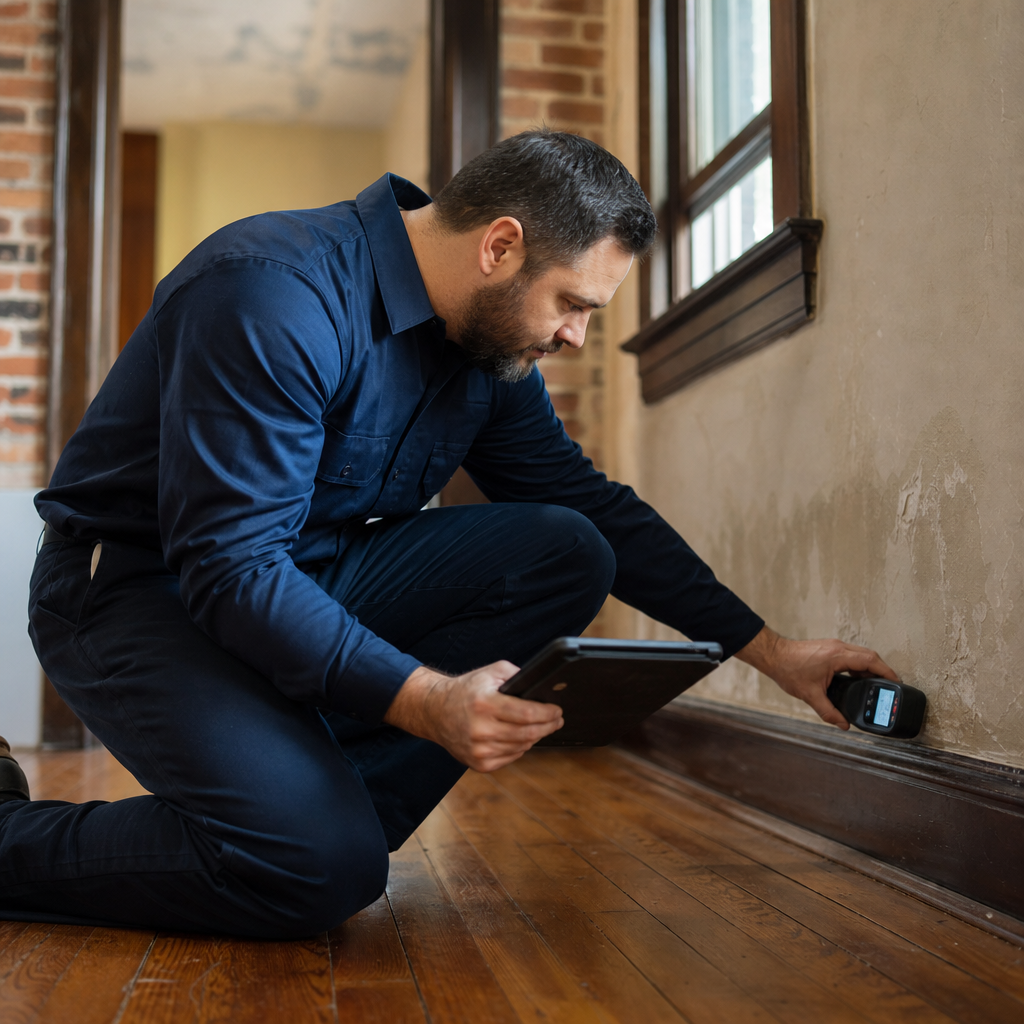
Yes. Historic plaster, wood lath, and multi-wythe brick walls can frequently be preserved using pressurized cavity-drying systems and industrial desiccant dehumidifiers instead of gutting the room down to bare framing.
Specialized Cavity Drying for Historic Lath and Plaster Party Walls
Many restoration companies default to swinging sledgehammers through original plaster simply because they lack non-invasive drying equipment. In historic East New York row houses, lime plaster keys and accordion wood laths soften when wet, while wet lath expands, a challenge frequently addressed by Wade’s Restoration – East New York. Tearing it down creates massive dust, drives up reconstruction costs, and strips out original architectural character.
We preserve original building materials using a non-destructive restoration process:
- Infrared Diagnostic Scans: We map the precise boundary of moisture inside dense plaster using FLIR thermal cameras and calibrated radio-frequency meters.
- Discreet Baseboard Access: Technicians remove baseboard trim and drill small, pencil-sized inspection ports along the floor line where they will remain hidden once the trim is reinstalled.
- Direct Positive-Pressure Airflow: Using Injectidry manifold systems, we push warm, ultra-low-grain air directly into stud bays and across masonry party walls.
- Controlled Moisture Evaporation: Commercial desiccant dehumidifiers pull ambient vapor out of the building, allowing wet lath and brick to dry in place without losing structural plaster integrity.
Preventing Mold Outbreaks in Attached Multi-Family Properties
Mold spores can germinate on damp organic materials in as little as 24 to 48 hours according to EPA guidelines. In attached two-family row houses and multi-unit brownstones, dampness inside shared masonry party walls easily travels sideways into neighboring apartments if left unaddressed.
Unlike modern drywall, wet wood lath and historical horsehair binder provide an abundant food source for mold species like Aspergillus and Stachybotrys. We monitor drying daily, confirming that structural brick and framing return to their natural equilibrium moisture content (EMC). This thorough monitoring protects the building’s indoor air quality and stops moisture problems from spreading to adjoining properties.
What Does Water Damage Restoration Cost in East New York, Brooklyn?
Need water damage restoration in East New York?
We’re available now - call for a fast, free estimate.
Based on New York regional rate surveys, standard Xactimate pricing datasets, and field estimates from Wade’s Restoration – East New York, clean water mitigation in an East New York home typically ranges between $1,500 and $4,500. More involved projects requiring historic cavity drying or biohazard sewage sanitization can run from $4,000 to over $10,000. Final pricing depends on the water category, total square footage affected, and the extent of finish reconstruction required.
Itemized Restoration and Mitigation Cost Breakdown
Costs vary depending on whether historic materials can be dried in place or require controlled removal. We prevent billing surprises by conducting thorough on-site inspections and providing detailed, written scopes of work before turning on equipment.
| Service Scope | Clean Water Mitigation | Historic Cavity Drying | Sewage Cleanup & Rebuild |
|---|---|---|---|
| Estimated Cost Range | $1,200 – $3,000 | $2,200 – $5,200 | $4,000 – $10,000+ |
| Plaster / Lath Preserved | High probability | Targeted salvage | Removal required for hygiene |
| Drying Equipment | Centrifugal air movers & LGR dehumidifiers | Injectidry manifolds & desiccant systems | HEPA air scrubbers & extraction pumps |
| Average Drying Time | 2 to 3 days | 3 to 5 days | 4 to 7 days |
Variables Impacting Your Final Restoration Estimate
Several key factors influence the total project cost during an emergency water loss in Brooklyn:
- Water Contamination Category: Clean water from an upper supply line requires standard extraction and drying. Category 3 sewage backups require strict personal protective equipment, containment barriers, specialized antimicrobial sanitizers, and hazardous waste disposal.
- Building Materials and Accessibility: Preserving original 1920s plaster, hardwood flooring, and multi-wythe brick through controlled cavity drying requires specialized desiccant equipment, but it saves thousands compared to full demolition and new construction.
- Elapsed Time Before Response: Standing water left past 48 hours increases structural saturation and leads to microbial growth, adding containment barriers and mold remediation to the overall project scope.
Using one trusted contractor for both emergency mitigation and structural repairs eliminates intermediate markup and scheduling delays between separate trades.
How Does Homeowners Insurance Cover Burst Pipes and Water Restoration in NYC?
Standard New York homeowners insurance policies (such as HO-3 and HO-5 forms) and commercial property policies generally cover sudden and accidental water damage. Examples include frozen pipes that split in winter, hot water heater failures, or dishwasher supply line ruptures. Standard policies typically exclude gradual, continuous leaks, deferred maintenance, and overland street flooding unless you carry a separate NFIP or private flood insurance rider.
Navigating Sudden and Accidental Plumbing Claims
Adjusters closely review claims to determine whether water damage happened suddenly or resulted from neglected, long-term leaking. If an overhead radiator pipe splits in a row house ceiling, the policy normally covers water extraction, drying equipment, drywall or plaster repair, and damaged flooring replacement.
Insurance policies place a contractual duty on the property owner to mitigate damage immediately. Calling an emergency restoration crew right away satisfies this policy condition, protects structural stability, and prevents adjusters from reducing payouts due to secondary neglect or delayed mold growth.
Our Insurance Coordination Process
To keep your insurance claim organized and clear of billing disputes, we assemble a complete documentation package for your adjuster from day one:
- Industry-Standard Xactimate Estimates: We write every line-item estimate using Xactimate, the same pricing software used by major insurance carriers across New York.
- Thermal and Photographic Evidence: We capture high-resolution date-stamped photos and infrared thermal scans of wet flooring, baseboards, and structural cavities prior to starting work.
- Daily Psychrometric Drying Logs: Technicians record moisture meter percentages, temperature, relative humidity, and grains per pound every 24 hours, proving when framing has reached stable equilibrium.
- Direct Adjuster Communication: We speak directly with your insurance adjuster, walking them through the initial scope, sharing drying data, and handling supplemental items so your claim processes smoothly.
Frequently Asked Questions About Water Damage Restoration in East New York
How quickly can an emergency water damage team arrive in East New York?
Wade’s Restoration maintains an on-call crew that targets an on-site response window of approximately 45 minutes across East New York, Cypress Hills, Brownsville, and surrounding Brooklyn neighborhoods under normal traffic conditions. Direct owner dispatch ensures immediate action to extract standing water and stabilize plumbing lines.
How long does the structural drying process usually take?
According to structural drying protocols from Wade’s Restoration – East New York, standard clean water drying takes approximately 2 to 3 days using commercial LGR dehumidifiers and high-velocity air movers. Historic plaster cavities, thick masonry party walls, or dense subfloors require 3 to 5 days using positive-pressure air injection and desiccant systems to ensure all trapped moisture evaporates safely.
Can historic hardwood floors and plaster walls be saved after a flood?
In many cases, yes. If mitigation starts within 24 to 48 hours of clean water exposure, specialized floor drying mats and intra-wall air systems can draw moisture out of tongue-and-groove hardwood and historic plaster without tearing them apart.
What steps should I take immediately after a pipe bursts?
First, turn off the main water shutoff valve to stop the flow of water. Next, turn off the electrical breakers to any flooded rooms to eliminate shock hazards. Avoid walking into standing water if electrical outlets are submerged. Finally, call Wade’s Restoration for emergency extraction and contact your insurance company to open a claim.
Do you manage both emergency extraction and complete rebuild repairs?
Yes. Our in-house team handles the entire project from initial emergency pumping, sewage sanitization, and moisture mapping through to plaster repair, insulation replacement, flooring installation, and finish carpentry. This keeps your recovery fast, clear, and fully coordinated under one roof.
Need water damage restoration in East New York?
We’re available now - call for a fast, free estimate.
Frequently Asked Questions
Does Wade's Restoration bill my homeowners insurance company directly for water mitigation?
Yes, Wade's Restoration works directly with your insurance adjuster, submitting itemized Xactimate estimates, date-stamped thermal photos, and daily moisture logs. In most covered emergency scenarios, we can bill your carrier directly so you are only responsible for your standard policy deductible.
How do I know if water in my basement is classified as hazardous Category 3 black water?
Any intrusion involving sewer line backups, toilet overflows, or street runoff containing soil and bacteria is classified as Category 3 black water. Wade's Restoration isolates these biohazards using HEPA negative-air containment and EPA-registered botanical biocides to prevent toxic aerosols from migrating into upper living spaces.
What happens if water damage penetrates a shared party wall into an adjoining East New York row house?
Because moisture rapidly wicks through historic masonry and wood lath, both property owners should immediately notify their insurers and request a joint moisture inspection. Wade's Restoration performs non-invasive infrared scans across shared walls to document the exact migration path and establish safe cavity-drying protocols for both residences.
About the author
 |
Marcus Bradley Marcus Bradley is a certified water damage restoration technician with over a decade of experience handling residential and commercial property emergencies. He holds a degree in Construction Management from the New York Institute of Technology and specializes in rapid moisture mitigation and structural drying techniques. Marcus provides actionable advice to help property owners minimize loss and navigate the complexities of restoration and insurance claims. |
Water damage, flood, or mold emergency?
We’re available now - call for a fast, free estimate.
Call Now - Free Estimate