
Quick Summary
In multi-family row houses and historic lofts, emergency water damage restoration in Bushwick requires rapid intervention to stop moisture from traveling through shared brick party walls and plaster ceilings. Wade's Restoration provides 24/7 live emergency response, utilizing non-invasive thermal moisture mapping, vacuum drying systems, and carrier-ready documentation tailored to local Brooklyn architecture. Property owners will learn immediate flood safety procedures and can contact Wade's Restoration 24/7 for fast water extraction, structural containment, and full property rebuilds.
Emergency Water Damage Restoration in Bushwick
When a supply pipe bursts or storm runoff floods your basement, getting water out fast is only half the battle. In Bushwick’s multi-family row houses, brownstones, and converted factory lofts, standing water travels quickly through porous brick party walls and pools above historic plaster ceilings. Left unmanaged, localized leaks can rapidly turn into multi-unit structural problems.
Proper water damage restoration requires a targeted approach to address moisture while working to preserve existing structures where possible. Wade’s Restoration – East New York works to extract water, map hidden moisture paths, and preserve salvageable materials. We manage recovery from initial water extraction through rebuild while supplying moisture documentation for insurance adjusters.[3] See also Water Damage Restoration in East New York | Call Now-10% Off | Same-Day Service | Free Estimate.
Quick answer: How does emergency water damage restoration work in Bushwick?
Emergency water damage restoration in Bushwick involves on-site water extraction, structural drying, and sanitization for residential and commercial buildings. Restoration technicians use extraction units, dehumidifiers, and thermal imaging to stabilize building materials, protect shared structural brickwork, and mitigate microbial growth.
Because Bushwick properties frequently share structural walls with adjoining buildings, restoration technicians prioritize containment. This prevents moisture from migrating horizontally across property lines while drying structural timber and plaster in place whenever safely possible.[4]
Immediate dispatch and arrival timelines
Brooklyn is one of the New York City boroughs with substantial flood exposure in official hazard planning documents. Official hazard planning records show that New York City experienced catastrophic flash flooding during Post-Tropical Cyclone Ida, resulting in 13 deaths, and NOAA disaster data records 95 billion-dollar weather events in New York between 1980 and 2024. In dense urban neighborhoods, rapid response is critical when addressing water intrusion. Restoration teams from Wade’s Restoration – East New York dispatch to Bushwick corridors along Knickerbocker Avenue, Bushwick Avenue, and Wyckoff Avenue to begin mitigation.[2]
Moisture containment procedures
Halting water migration through attached residential and commercial properties requires a systematic process:
- Bulk Water Extraction: Industrial pumps and extraction tools remove standing water from basements, ground-floor apartments, and storefronts.
- Non-Invasive Moisture Mapping: Technicians use infrared thermal cameras and calibrated pinless moisture meters to track water moving behind shared brick party walls and under hardwood flooring.
- Structural Dehumidification: High-capacity dehumidifiers run alongside directed air movers to pull deep moisture out of structural wall cavities without unnecessary demolition.
How does water travel through brick party walls and plaster ceilings?
Need emergency water damage restoration in Bushwick?
We’re available now - call for a fast, free estimate.
Water moves through masonry via capillary action, commonly known as wicking. Unsealed historic brick absorbs moisture like a sponge, drawing water horizontally across party walls into neighboring row houses and down into structural joist pockets. At the same time, water from upper-floor plumbing leaks seeps through subfloors and settles into traditional plaster and wood lath assemblies. Without specialized drying equipment, this trapped moisture weakens plaster keys and causes structural framing to rot.
Lateral moisture migration in attached structures
Attached 1920s to 1940s brick buildings throughout Bushwick share continuous masonry walls. When a second-floor pipe fails or roof drains overflow, water does not stay confined to a single room; it spreads sideways through the shared brickwork. Official records indicate that every county in New York State has seen flooding over the past 12 years. Protecting attached structural masonry requires specialized drying strategies. Technicians use thermal imaging to identify hidden migration paths, applying targeted air pressure to dry the brick in place rather than removing shared walls down to the studs.[5]
Drywall, plaster, and subfloor: repair versus replace criteria
Historic plaster and lath systems can often be salvaged if the plaster keys (the plaster pressed between lath strips) remain structurally sound. Technicians from Wade’s Restoration – East New York inspect saturation levels and structural integrity before deciding whether to dry materials or remove them.
| Building Material | Moisture Impact | Restoration Protocol |
|---|---|---|
| Historic Plaster & Lath | Trapped moisture behind plaster keys | Cavity drying via targeted high-velocity airflow |
| Original Hardwood & Joists | Cupping, subfloor saturation | Negative-pressure vacuum drying mats |
| Modern Drywall | Wicking along lower wall edges | Precision flood-cut removal up to the clean, dry line |
Salvaging hardwood floors and joists with targeted drying
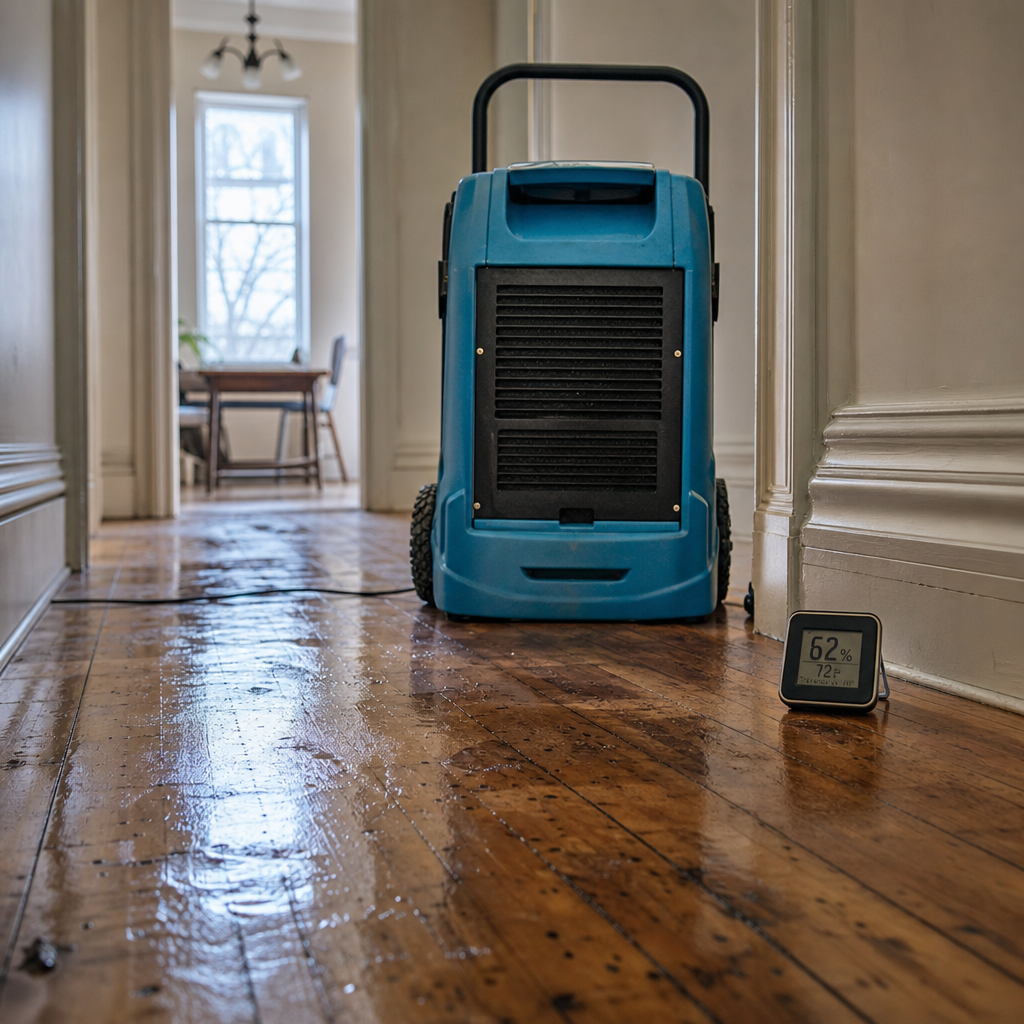
Rather than tearing out original hardwood floors after a flood, technicians install negative-pressure drying mats. These sealed vacuum systems draw trapped moisture straight up through the wood pores and subfloor joists. By pulling warm, dry air down into the subfloor framing, this equipment reverses wood cupping, protects structural floor joists, and preserves historic woodwork that would cost thousands of dollars to replace.
What factors determine the cost of emergency water damage restoration in Bushwick?
Restoration costs depend on the water source category, the square footage affected, and the degree of structural saturation. Clean water from a supply pipe break requires straightforward extraction and drying. In contrast, Category 3 black water from a sewer backup or street-level storm runoff demands full antimicrobial treatment, containment barriers, and personal protective equipment. Every property requires an on-site inspection with moisture meters to generate a clear, itemized scope of work.
General cost considerations for restoration services
In Brooklyn, 14,350 buildings, or 23.26%, are predicted to be damaged in a 1% annual chance floodplain event in NYC. Low-lying basements and garden-level apartments near heavy runoff corridors require different mitigation approaches depending on contamination levels.[1]
| Feature | Category 1: Clean Water | Category 2: Grey Water | Category 3: Black Water |
|---|---|---|---|
| Cost Factors | Direct extraction, standard drying | Antimicrobial wash, targeted drying | Extensive decontamination, selective disposal |
| Common Source | Supply pipe or faucet break | Washing machine or dishwasher overflow | Sewage backup, street flood runoff |
| Drying Strategy | In-place structural drying | Sanitization with targeted cavity drying | Deep extraction, containment, HEPA air scrubbing |
| Plaster & Lath Impact | Preserved without tear-out | Preserved through cavity airflow | Removed if porous materials are contaminated |
Insurance documentation and moisture logs
Filing an insurance claim for water damage requires objective proof of loss. Adjusters routinely dispute vague contractor estimates. Wade’s Restoration – East New York provides itemized scopes, room-by-room photographic evidence, and moisture logs documenting humidity, temperature, and material moisture content throughout the dryout process to assist adjusters with claim evaluations.
What steps should you take while waiting for water extraction technicians?
Need emergency water damage restoration in Bushwick?
We’re available now - call for a fast, free estimate.
The actions you take after discovering water can prevent secondary structural damage. Focus on occupant safety and stopping the flow of water before technicians arrive.
Immediate electrical and water shutoff protocols
Take these safety steps as soon as you discover standing water:
- Shut off the main water valve: Turn the primary shutoff valve clockwise to stop the water source immediately and relieve pressure on compromised plumbing lines.
- Disconnect power to affected circuits: If the electrical panel is safely accessible in a dry area, switch off the circuit breakers for flooded rooms to eliminate shock hazards.
- Never enter standing water near outlets: If standing water has reached wall outlets or power cords, stay out of the room until utility workers or technicians confirm the power is cut.
Protecting contents and avoiding contamination hazards
Secondary damage happens when contents absorb moisture from wet floors and humid air. Protect your belongings with these simple precautions:
- Elevate wooden and upholstered furniture: Place small squares of aluminum foil or plastic wrap under wooden furniture legs to stop moisture from wicking into the wood.
- Remove area rugs and soft goods: Lift area rugs, draperies, and bedding off wet floor surfaces to prevent dye bleeding and fabric rot.
- Avoid domestic vacuums: Never use a standard household vacuum to suck up water. Household units are not rated for wet extraction and present a severe electrocution hazard.
Frequently asked questions about Bushwick water damage restoration
Managing water damage in dense Brooklyn neighborhoods requires clear information and fast action. Here are answers to common questions about pricing, insurance, and building stabilization.
Common concerns on pricing, insurance, and response times
How quickly can an emergency water restoration team arrive in Bushwick?
Restoration crews work to dispatch promptly to Bushwick properties following an emergency call. A swift response helps halt the spread of moisture through shared party walls and protects structural materials from further damage.
Does homeowner insurance cover sudden water pipe bursts in Bushwick apartments?
Homeowner insurance policies generally cover sudden and accidental water damage from burst pipes. They typically do not cover long-term, unaddressed leaks. Having detailed moisture readings and itemized restoration reports helps adjusters evaluate claims accurately.
Can mold develop following water damage in a basement?
Yes. Under damp conditions, mold can develop on organic materials like drywall paper, subflooring, and plaster backing. Prompt structural drying and dehumidification help reduce the risk of microbial growth.
Do emergency restoration companies handle both water cleanup and structural repairs?
Wade’s Restoration – East New York provides end-to-end recovery, handling water extraction, structural dehumidification, and rebuild services to return properties to pre-loss condition.
Need emergency water damage restoration in Bushwick?
We’re available now - call for a fast, free estimate.
Sources
- Blue Zones: Identifying Adaptation Opportunities Using Past … – PMC – pmc.ncbi.nlm.nih.gov (2080)
- Billion-Dollar Weather and Climate Disasters | New York Summary – ncei.noaa.gov (2024)
- DiNapoli: Extreme Weather and Disaster Response Costs Rise in NY – osc.ny.gov
- Zoning for Coastal Flood Resiliency – bers.nyc.gov – bers.nyc.gov
- Historical NFIP Claims Information and Trends – floodsmart.gov
Related reading: Emergency Water Damage Restoration in East New York | Call Now-10% Off | On-Site in 60 Minutes | Free Estimate
Related reading: Water Damage Restoration in Williamsburg – Call Now-10% Off – Same-Day Service – Free Estimate
Related reading: Water Damage Restoration in Canarsie | Call Now-10% Off | Same-Day Service | Free Estimate
Frequently Asked Questions
How do technicians stop water from spreading across shared brick party walls to neighboring properties?
Wade's Restoration uses non-invasive infrared thermal imaging to map hidden moisture paths and deploys directional cavity drying equipment against porous masonry. This targeted airflow extracts trapped moisture from the brickwork and joist pockets, halting lateral capillary migration before it affects adjacent row house units.
Can saturated historic hardwood floors be restored without full replacement after a flood?
Yes, historic hardwood can often be saved if structural drying starts immediately. Wade's Restoration installs negative-pressure vacuum drying mats that draw water up through the floor pores and subfloor framing, reversing wood cupping and preserving original Brooklyn woodwork.
What documentation do insurance carriers require for multi-unit emergency water damage claims?
Adjusters require carrier-ready proof of loss, including daily psychrometric logs, thermal imaging scans, and itemized scopes of work. Wade's Restoration compiles room-by-room moisture documentation and photographic records throughout the dryout process to validate the claim and prevent payout disputes.
About the author
 |
Marcus Bradley Marcus Bradley is a certified water damage restoration technician with over a decade of experience handling residential and commercial property emergencies. He holds a degree in Construction Management from the New York Institute of Technology and specializes in rapid moisture mitigation and structural drying techniques. Marcus provides actionable advice to help property owners minimize loss and navigate the complexities of restoration and insurance claims. |
Water damage, flood, or mold emergency?
We’re available now - call for a fast, free estimate.
Call Now - Free Estimate